
What is a nature-based outdoor school?
In summary, nature-based schools (called forest schools, nature schools, outdoor enrichment programs, forest kindergarten, nature preschool) are all-weather outdoor education programs that utilize nature immersion and place-based curriculum to develop cognitive, physical, social, and emotional skills in children.
The traditional forest school model popularized in Europe in the early 1830s include the following primary principles:
» Outdoors in all weather
» Child-led flow learning
» Guided risk taking
» Place-based curriculum
» Environmental stewardship
» Small class sizes
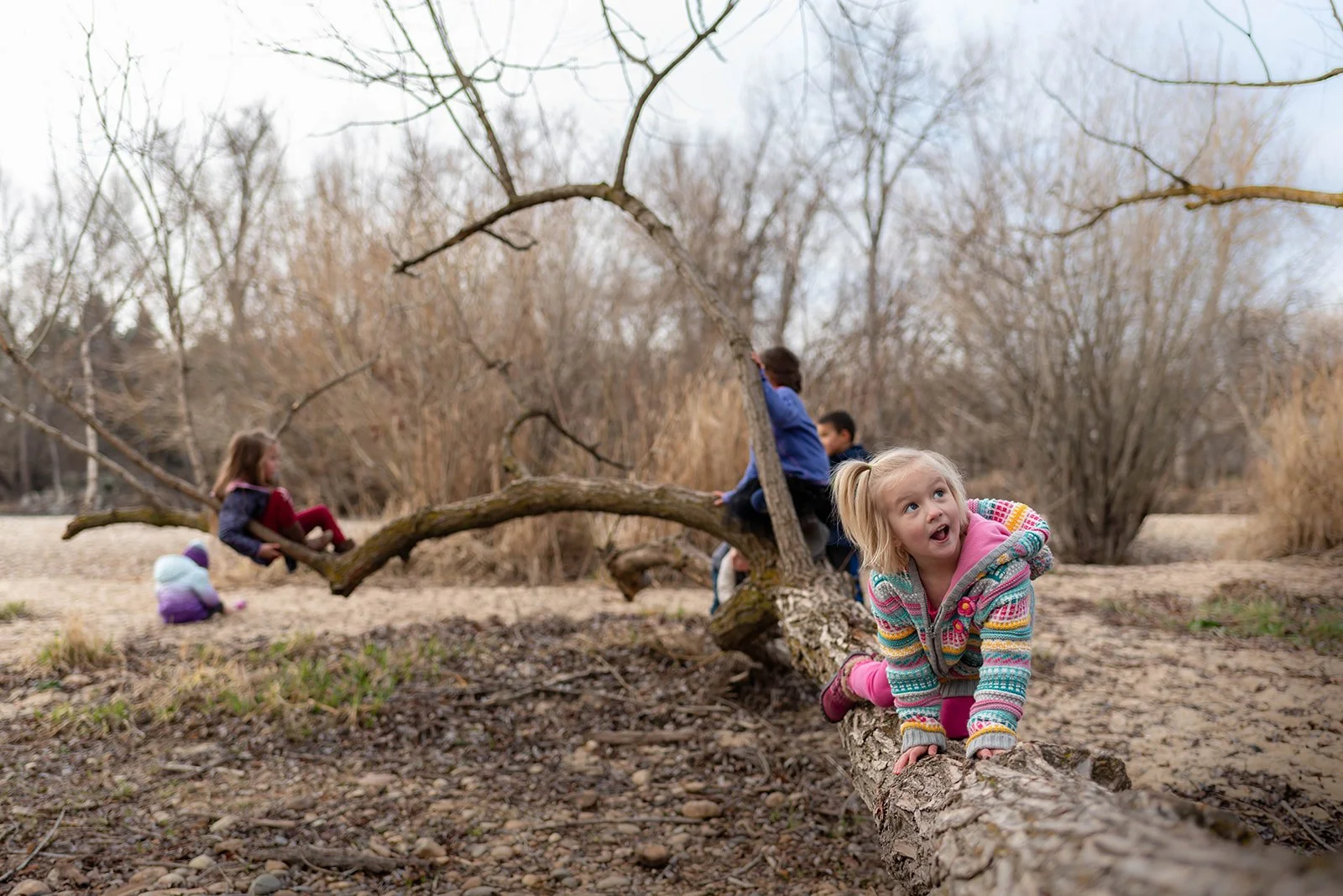
Why Forest School?
There are countless reasons to incorporate a forest school education with conventional methods of learning. For one, forest school programs naturally focus on hands-on (experiential) learning techniques in the subjects of science, mathematics, engineering, literacy, writing, and art. Forest schools allow children to seamlessly apply the scientific method of developing questions, testing hypotheses, and creating conclusions that inform their theories and worldview. In addition, the forest school pedagogy nurtures children’s independence, emotional intelligence, and sense of community. The forest school teaching philosophy is based in the education of the whole child and does not focus on arbitrary academic milestones.
Studies have found the following outcomes for children attending Forest Schools:
Academic Outcomes
» Increased retention of subject matter
» Higher standardized scores
» Improved grades overall
» Elevated math, reading and writing skills
» Higher graduation rates
Personal Development Outcomes
» Increased empathy, leadership, and communication skills
» Enhanced resilience
» Heightened critical thinking and problem solving
» Better spatial skills
Mental Health and Well-Being Outcomes
» Increased psychological well-being
» Reduction in depression, anxiety, & stress
» Lessened Attention Deficit/Hyperactivity Disorder (ADHD) symptoms
» Decreased occurrences of obesity & asthma
Positive Stewardship Outcomes
» Stronger connection to nature
» Increased environmental values
» Pro-environmental behaviors into adulthood
Ready to join the nature school movement?
References + Resources
Sampling of Research Articles
Nature-based education and kindergarten readiness: Nature-based and traditional preschoolers are equally prepared for kindergarten.
Children in nature-based and traditional preschools are equally prepared for kindergarten.
Cordiano, T.S., Lee, A., Wilt, J., Elszasz, A., Damour, L.K., Russ, S.W., (2019). Nature-based education and kindergarten readiness: Nature-based and traditional preschoolers are equally prepared for kindergarten. International Journal of Early Childhood Environmental Education, 6(3), 18-36.
The benefits of children’s engagement with nature: a systemic literature review.
Playful styles of nature engagement yield multiple benefits for children.
Gill, T., (2014). The benefits of children's engagement with nature: A systematic literature review. Children, Youth and Environments, 24(2), 10-34.
What is different about Forest School? Creating a space for an alternative pedagogy.
The divergence and freedoms inherent in Forest School may contribute to the well-being of participants
Waite, S., Goodenough, A., (2018). What is different about Forest School? Creating a space for an alternative pedagogy. Journal of Outdoor and Environmental Education, 21(1), 25-44.
A forest-based environment as a site of literacy and meaning making for kindergarten children.
A forest environment provides kindergarten children with rich opportunities for literacy and meaning making
Streelasky, J., (2018). A forest-based environment as a site of literacy and meaning making for kindergarten children. Literacy
Reloading pupils' batteries: Impact of green spaces on cognition and wellbeing.
Study breaks in green spaces improved well-being and cognitive performance of adolescents
Wallner, P., Kundi, M., Arnberger, A., Eder, R., Allex, B., Weitensfelder, L., Hutter, H., (2018). Reloading pupils' batteries: Impact of green spaces on cognition and wellbeing. International Journal of Environmental Research and Public Health, 15(6)
The impacts of unstructured nature play on health in early childhood development: A systematic review.
Nature play may positively impact children’s health and development, particularly in the areas of physical activity and cognitive development
Dankiw, K.A., Tsiros, M.D., Baldock, K.L., Kumar, S., (2020). The impacts of unstructured nature play on health in early childhood development: A systematic review. PLoS ONE, 15(2)
Books
Last Child in the Woods
By Richard Louv
There’s No Such Thing as Bad Weather
By Linda Åkeson McGurk
Balanced and Barefooot
Angela J. Hanscom
Online Resources
National Association for the Education of Young Children